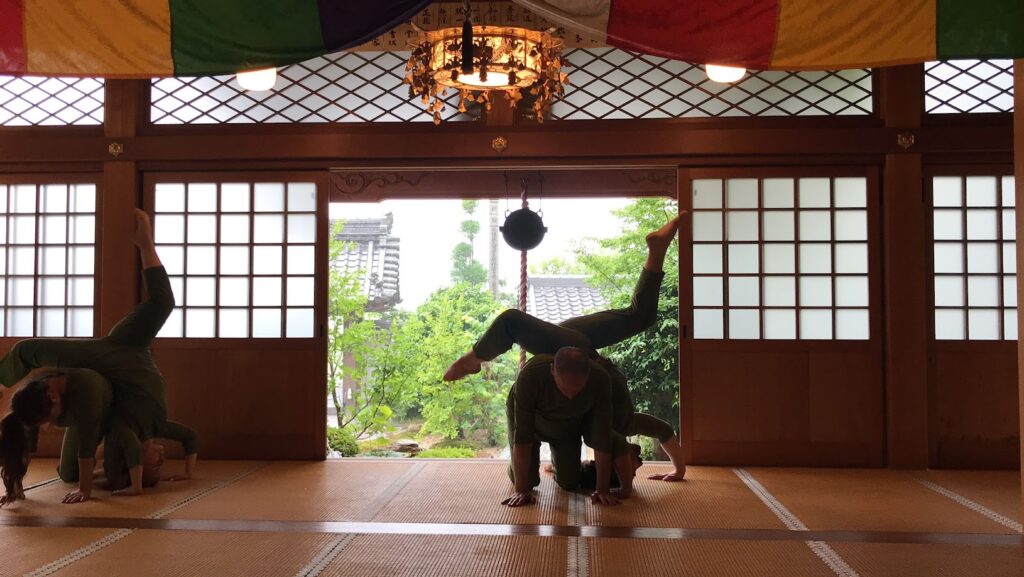
An annual tradition, Attune bringing together artists from Japan and the United States. The dances in this year’s performances explore the theme of restoration, reassembling the scattered pieces of ourselves to become whole.
Daya Tomiko transforms a classic work of Bharata Natyam by adding new layers, renewing a classical foundation with contemporary inspiration.
Heidi S Durning, accompanied by Noh flautist Kumiko Nonaka, will blend Japanese Classical Dance with contemporary dance in a solo about fan techniques. Durning gathers air currents into a stream around her.
Kyoko Fujimoto presents two contemporary dance solos that explore the desires hidden in the depths of the human psyche, using “slacking off” and “gluttony” as starting points.
Karen Fox presents “Sisters of Forgiveness.” This trio explores the nature and history of forgiveness, with elements of ancestral knowledge and contemporary personal and social behaviors woven together into a living tapestry.
Along similar lines, Malcolm Shute presents “Tapestry,” in which dancers represent threads weaving through fabric hanging from a wall: tangled shapes and hooking limbs. It simultaneously references relationships that hold us up and strengthen our lives. Shute also presents “Mid Flight,” a duet about dragonflies hovering low over water. It also reminisces about time spent on an international flight, changing time zones, without phone calls or internet, a suspended time.
Emily Crews and Carrie Monger present “Baller,” a study of how to loosen up and embrace the process of aging with humor and humility. The artists have learned that self-compassion, as well as leaning into their friendship, has made aging easier and a lot more fun!
“What it is, is what it was going to be in the first place- secondly,” choreographed by Nick M Daniels and performed by Claytor Company, fuses African, modern, and Butoh dance styles. The dancers navigate a shifting landscape of tension and release: at times bound by invisible forces, individuals also step outside the collective rhythm to find their own. The piece calls on us to question and resist power, leading to change.
Sylvana Christopher presents “Pebbles at the River’s Edge” which reflects a boulder eroding into pebbles, then collecting anew on the riverbed.
“Mosi-oa-Tunya (The Smoke That Thunders): We Are the Water,” by Stacey Yvonne Claytor, is inspired by the majesty of Victoria Falls, a sacred place where rushing water rises as mist. The dancers move like living currents: surging, spiraling, and cascading, a testament to water’s enduring power to cleanse, restore, and reconnect us.